Corrosion of Hot Dip Galvanized Rebars in Concrete under the Attack of Chlorides and Freeze-Thaw Cycles

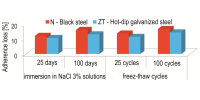
This paper presents a mathematical model for the simulation of physical phenomena that appear in the hot dip galvanized rebars corrosion process, compared with the bare steel rebar in concrete, under the attack of chlorides and freeze-thaw cycles. The physical and corresponding mathematical model are presented and the system of governing equations along with initial and boundary conditions were established. The associated numerical model and the numerical methods of discretization and solving the differential equations system on which the mathematical model is based are also presented. The following parameters were considered: concrete humidity, chloride ions content and temperature variation. The time until corrosion initiation, rebar’s diameter reduction, the advance of the corrosion products front and corrosion current variation were determined, according to environment conditions, exposure time and type of rebar used.


    

Electrochemical Investigation on the Corrosion Behavior of Combined Addition of Cu and Ni to Al-Si-Mg Alloy in 0.1M NaCl Solution

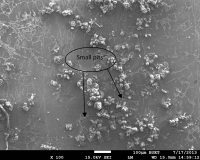
Fig. 6: SEM images of the damage surface morphology of Alloy-2 in NaCl solution

The purpose of this paper is to understand the effect of 2Cu+2Ni addition on electrochemical corrosion behavior of thermal treated Al-6Si-0.5Mg alloy in 0.1M NaCl solution. The corrosion of the thermal treated samples was characterized by electrochemical potentiodynamic polarization technique consisting of linear polarization method using the fit Tafel plot and electrochemical impedance spectroscopy (EIS) techniques. Generally, from the linear polarization, the corrosion rate decreases at thermal treated Al-6Si-0.5Mg-2Cu-2Ni alloy (Alloy-2). The corrosion behavior of the Alloy-2 in the 0.1M NaCl solution showed better resistance than the Alloy-1. The EIS test results also showed that the changing of charge transfer resistance (Rct) is significant with the combined addition of 2Cu+2Ni to Al-6Si-0.5Mg alloy. The magnitude of the noble shift in the open circuit potential (OCP), corrosion potential (Ecorr) and pitting corrosion potential (Epit) increased with the addition of 2Cu+2Ni to Al-6Si-0.5Mg alloy.


The first year of the master program in Electrochemistry and Electroplating

Sought-after experts – the Technische Universität Ilmenau (TU Ilmenau) offers a master program in Electrochemistry and Electroplating

Being a small but well-established university located in the centre of Germany, the TU Ilmenau is widely known for its combination of a high standard of training, a convincing campus and a personal atmosphere, thus representing a very pleasant and attractive place of study.

Technische Universität Ilmenau (TU Ilmenau). © ari

Technische Universität Ilmenau (TU Ilmenau).
© ari

One year ago, the university extended its rich and mainly engineering-oriented profile by a new master program in Electro- chemistry and Electroplating (four semesters), behind which there is a whole industry represented by the German Central Association of Surface Engineering (Zentral-verband Oberflächentechnik, ZVO). The master course aims to develop highly qualified professionals as junior staff for the electroplating and surface treatment industry. Continue reading…

Magnetic property and corrosion resistance of electrodeposited nanocrystalline cobalt-nickel alloys

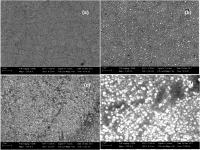
Fig. 3: SEM micrographs Co-Ni coatings deposited at (a) 2.0 A dm-2 (b) 4.0 A dm-2 (c) 6.0A dm-2 (d) 8.0 A dm-2, from optimal bath

In the present investigation we have galvanostatically synthesized Co-Ni nanocrystalline alloys on copper substrate. The effect of current density (c.d.) on composition, surface morphology and phase structure were studied for explaining the magnetic and corrosion resistance of the alloy. The bath found to exhibit the preferential deposition of less noble Co than Ni, and at no conditions of c.d., the deposition has changed from anomalous to normal type. Surface morphology and structural characteristics of the deposits were examined using scanning electron microscopy (SEM) and X-ray diffraction (XRD) analysis. As composition of the alloy varied, consequent to the c.d. a change of hexagonal close packing structure (hcp) to face centered cubic structure (fcc) was observed. Finally, the conditions responsible for peak magnetic property and corrosion resistance were optimized. Factors responsible for improved functional properties were explained in terms of surface morphology and crystalline grain size of the coatings.


The Use of Molybdate, Chromate and Tungstate Anions as Corrosion Inhibitors for Steel in Sulfide Polluted Salt Water

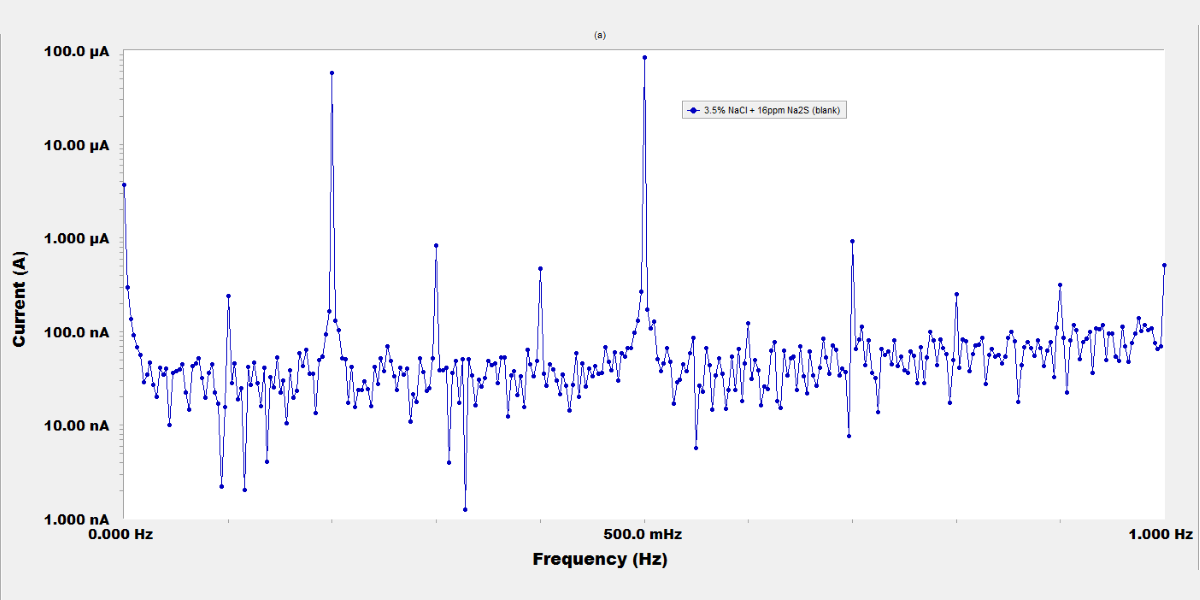
The inhibiting effect of molybdate, chromate, and tungstate salts on the corrosion of steel used in sanitation plants was investigated by potentiodynamic polarization, electrochemical impedance spectroscopy (EIS), and electrochemical frequency modulation (EFM) techniques. The sulfide polluted salt water was simulated by a 3.5 % NaCl and 16 ppm Na2S solution. The results revealed that these inorganic anions are very good inhibitors. Potentiodynamic polarization curves indicated an anodic-type inhibition. The increased concentration of inorganic compounds increases the inhibition; at 250 ppm concentration the inhibition efficiency reached to 95 %, 91.6 %, and 87.5 % for MoO42-, CrO42-, and WO42-, respectively. The adsorption of the inhibitors on the metal surface basically obeys the Langmuir adsorption isotherm equation. Results of EIS measurements suggested that the dissolution of the steel occurs under activation control, and a passive film is probably formed on the metal surface. The electrochemical kinetic parameters calculated from EFM spectra confirm the polarization data.