Effect of additives and operating parameters on deposit characters of Ni-Cd alloy

Figure 3

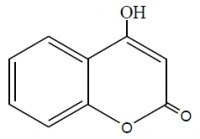
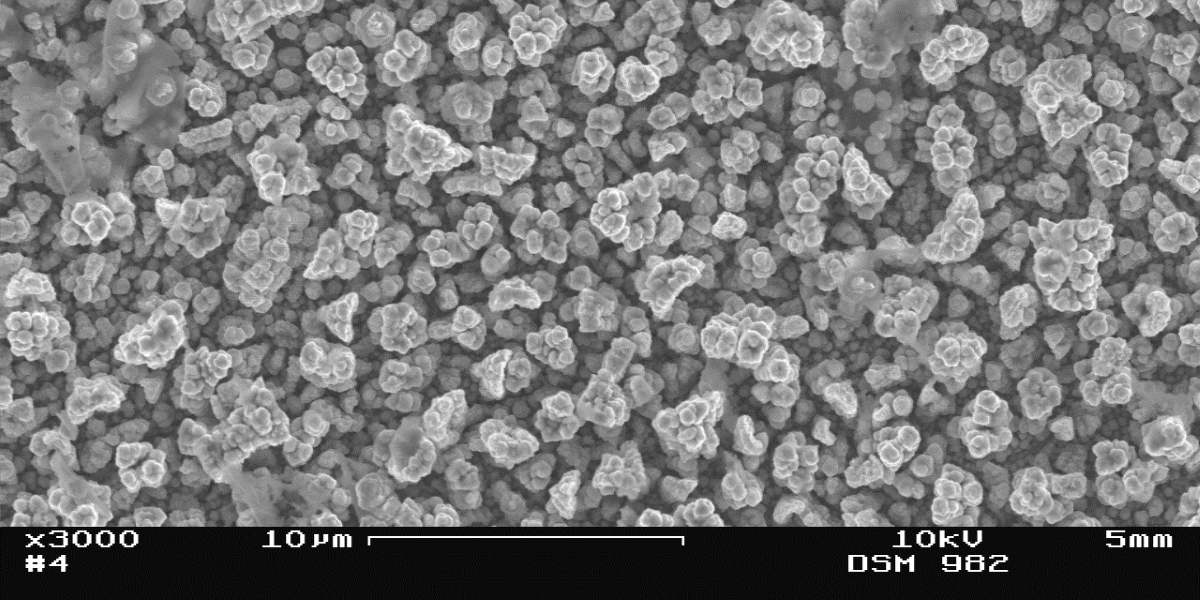
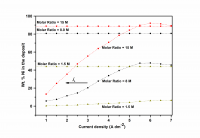
The Ni-Cd alloy coating was electrodeposited on mild steel (MS) from acid chloride bath using gelatin and glycerol as additives, individually and in combination. The bath composition and operating parameters have been optimized by conventional Hull cell method. The effect of current density (c.d.) on Ni content of the alloy was studied at different molar ratio of metal ions in the bath. The effects of c.d. and temperature on thickness, hardness, and composition and corrosion rate (CR) of the coatings were studied. Cyclic voltammetry (CV) study showed that (gelatin + glycerol) has significant effect on process of deposition and (gelatin + glycerol) worked synergistically to increase the Ni content by their preferential deposition and by suppressing the deposition of more readily depositable Cd2+ ions. Ni-Cd bath having both [Ni2+]/[Cd2+] = 1.5 and 8.0 exhibited anomalous type of codeposition at all c.d.’s studied. Corrosion behavior of the coatings evaluated by electrochemical methods demonstrated that the coating from bath [Ni2+]/[Cd2+] = 15, deposited at 4.0 A dm-2  is the most corrosion resistant. The superior corrosion resistance of Ni-Cd coatings at optimal c.d. was attributed to specific Ni (111), Ni (200), Cd (200) and Ni-Cd (862) reflections, evidenced by XRD study. The surface morphology was analyzed using SEM study, and results are discussed.


    

Electrochemical Investigation on the Corrosion Behaviour of Mg-Al-Zn-Mn (GA9) Alloy in Sodium Chloride Medium

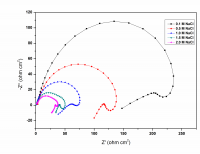
Fig. 2: Nyquist plots for the corrosion of GA9 magnesium alloy in different concentrations of NaCl solutions at 40°C

The corrosion behavior of Mg-Al-Zn-Mn (GA9) alloy in sodium chloride solutions was studied over a range of concentrations and solution temperatures by electrochemical techniques like potentiodynamic polarization (PP) and electrochemical impedance spectroscopy (EIS). The studies were carried out in solutions with NaCl of concentrations between 0.1M – 2M; and at different temperatures in the range of 30 C – 50 C. The studies have revealed that the corrosion rate of GA9 magnesium alloy increases with the increase in temperature and also with the increase of NaCl concentration in the medium. Activation parameters like activation energy, enthalpy of activation and entropy of activation for evaluation of the corrosion process were calculated. The results from both the techniques are in good agreement with each other. The alloy surface morphology was studied before and after corrosion using scanning electron microscopy (SEM).


Coumarin Derivatives as Corrosion Inhibitors for Zinc in HCl Solutions

(a) 4-hydroxy - coumarin

The inhibiting effect of some coumarin derivatives toward the corrosion of Zinc in 0.1M HCl solution was studied using weight loss and galvanostatic polarization techniques. Addition of KI to acidic medium containing the coumarin derivatives increases the inhibition efficiency of the system. The obtained results showed that the inhibition efficiency of these compounds increased by increasing their concentrations and decreased by rising the temperature, so that the adsorption of these compounds is physically adsorbed on the zinc surface. Temkin’s adsorption isotherm fits the experimental data for the studied compounds. Some thermodynamic parameters for the adsorption and activation process were computed. The values of Tafel slopes indicate that these compounds act as a mixed type inhibitors but cathode is more polarized when an external current was applied. The inhibitors are explained in terms of adsorption on the zinc surface. The order of inhibition efficiency are interpreted on the basis of the molecular structure, the subsistent groups and their charge densities of the coumarin derivatives.


Phosphorus Determination of Electroless Nickel Depositions from Printed Circuit Boards (PCB) by means of EDXRF

The principles of energy dispersive x-ray fluorescence (EDXRF) technique and its elemental analysis applications were described in some books and reviews [1-4]. PCBs are an important application for nickel-phosphorus (NiP) coatings, on top of which, additional gold and/or palladium coatings are applied. Phosphorous concentration of chemically (or electroless) deposited nickel-phosphorus (NiP) coating can be analyzed in nondestructive manner in atmosphere without stripping Au and Pd coatings. The FP-based WinFTM software allows a reliable determination of both the mass per unit area of the NiP layer and its P concentration [5]. The reproducibility and accuracy of the analysis is verified by means of certified standard reference material. Their quantification is traceable to accurate mass per unit area primary standards analyzed by several suitable techniques [6]. The typical measurement spot size is about 1mm, but in case of micro-spot instruments even smaller spot sizes (less than 100 µm) are achievable.


Electrochemical removal of nitrate from waste water

The reduction process of nitrate at copper based electrodes was investigated. The cyclic voltammetry (CV) studies allowed us to establish the specific parameters concerning the electrodeposition of the individual metals and their alloys. It was demonstrated that the products resulting from electrochemical nitrate reduction (ENR) in alkaline media can be detected by cyclic hydrodynamic voltammetry (CHV) and square wave voltammetry (SWV) techniques at Cu and CuSn plated Pt electrodes. Moreover, using SWV ammonium can be electrochemically detected with good accuracy. An enhancement of the electrocatalytic activity of Cu by alloying it with Sn was observed. The reduction of nitrate was investigated in an engineering laboratory scale flow reactor under different operating conditions. On the two investigated types of cathode materials (Cu and CuSn), the concentration of nitrate was reduced electrochemically to the maximum permissible limit (50 mg/L) with a energy consumption in the range of 2 – 16 kWh/kg NaNO3 at a CuSn cathode.