Finite element simulation of nickel electroplating process of a revolving part

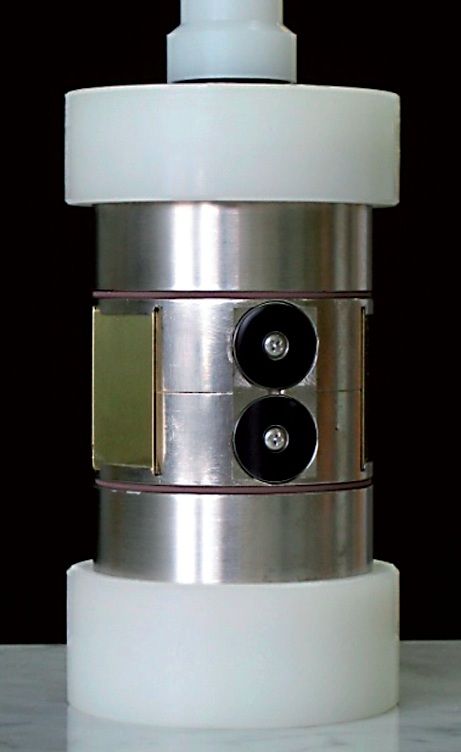
Fig. 2: Electroplated sample

Process simulation and optimization with the help of numerical methods can reduce expensive and time consuming experiments for manufacturing good quality products. Electroplating is a prominent coating process that the quality and uniformity of the deposition are of great importance in this process. In this paper a finite element model has been proposed for evaluation of primary and secondary current density values on the cathode surface in nickel electroplating operation of a revolving part. In addition, the capability of presented electroplating simulation has been investigated in order to describe the electroplated thickness of the nickel sulfate solution. Nickel electroplating experiments have been carried out and the measured thickness in different points have been compared with the predictions. A good agreement between the simulated and experimental results was found. Also the results showed that primary current density can describe the general form of thickness distribution but the relative value of current density using secondary current density can present better description of thickness distribution.


    

Microstructure and Particle Incorporation Behavior of Electrocodeposited Ni-Al2O3 Nanocomposites

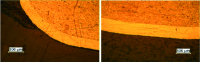
Nickel-alumina composite films were obtained by electrocodeposition using different deposition techniques, viz. direct current (DC) deposition and pulse-reverse plating (PRP). Particle incorporation was determined by means of energy-dispersive X-ray spectroscopy and glow discharge optical emission spectrometry (GD-OES). The structure of the films was analyzed using electron microscopy, viz. scanning electron microscopy (SEM), electron backscatter diffraction (EBSD), transmission electron microscopy (TEM), and X-ray diffraction. A <100> fiber texture was found for pure nickel films, which was reduced due to a change in plating conditions and particle incorporation. EBSD mappings indicate that the nanosized particles inhibit nickel growth and thus lead to a smaller nickel crystallite size combined with a distinct loss of the <100> texture. Scanning transmission electron microscopy (STEM) and TEM reveal that the inclusion of alumina nanoparticles preferentially takes place in the grain boundary region where the particles terminate the growth of nickel. High-resolution TEM imaging proves a complete embedding of nanoparticles by the nickel matrix without any voids.


Electrochemical Deposition and Microstructure Characterization of Lead-Tin-Layers

Fig. 3

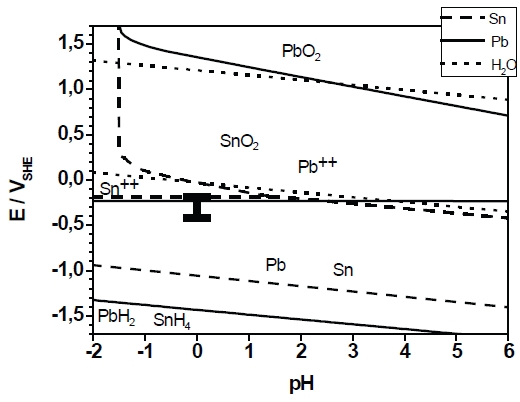
The present study investigated the formation of a binary alloy of lead and tin. Both elements represent a thermodynamic system with strongly limited miscibility in solid state. The deposition of the layers was carried out under potentiostatic conditions at various deposition potentials from a sulfonate-based electrolyte. The layer formation was characterized by electrochemical techniques (cyclovoltammetry, chronoamperometry). The microstructure development was investigated by SEM/EDX measurements and X-ray diffraction. The layer formation is compliant with the Stranski-Krastanov growth mode. The current efficiency of the deposition was approximately 100%. According to the thermodynamic theory the layers show a dual-phase microstructure. The composition of the Pb-Sn layers was depending on the deposition potential. Supersaturated α-Pb-solid solution could not be observed. The morphology is also strongly depending on the deposition potential. The diffusion coefficient of the metal ions in the sulfonat-based electrolyte was measured by rotating disc electrode experiments. The formal diffusion coefficient in the electrolyte containing Pb2+– and Sn2+– ions is close to the diffusion coefficient of lead ions.


A Tribological Study on the Ball-on-Disc (BOD) Method, Taking Steel and Galvanic Hard Gold as Examples

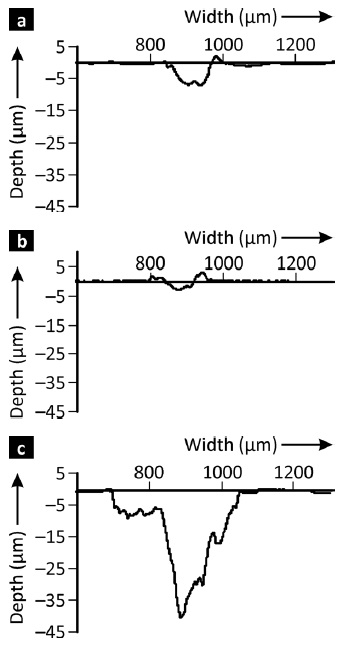
This work was motivated by utilisation of the widespread ball-on-disc (BOD) method for potentially characterizing galvanically deposited layers, especially gold/copper/cadmium alloy layers (“hard gold”) deposited on polished 100Cr6-steel discs (Φ 18 mm) using a special module. The friction balls consisted of smooth alumina and exhibited a diameter of 6 mm. For comparison, similar experiments were made on pure steel-discs. Besides of friction diagrams, profiles were detected by means of a separated profilometer allowing the volumetric determination of the abrasion (wear). To visualize their often irregular shapes, the shape of the friction ball was placed computationally onto the grooves. Due to the semi-chaotic process, the reproducibility was only minor. Nevertheless, some fundamental tribological relations could be found. In particular, the established hypothesis of Achard and the related assumption of a material-specific, time-independent wear coefficient appeared to be inappropriate and thus untenable. Rather, observation showed that wear decreases not linearly but over-proportionally over time, particularly implicating the number of cycles (laps). Furthermore, when the rotation rate increases, a higher load is required to ensure steady abrasion. Although this method allows numerical characterizations of galvanic layers by means of specific constants such as the friction impact constant KW, revealing an obvious qualitative difference between steel and hardgold-plated steel, it is probably not optimum for such systems since it deviates too much from the real conditions of operation. However, the hereby found tribological laws could be of eminent general interest.


Posted in General | Tagged , ,

Sol-Gel Coating for Aluminum Alloy: Self-Healing Characteristics

Water-based sol-gel coatings have been developed in the last years as cost-efficient and environmentally friendly protective layers. The stability of sol-gel films is often limited in the absence of functional compounds to generate self-healing. In this work, a water-based sol-gel coating was applied on aluminum alloy 6082. Benzotriazole and cerium nitrate were used as dopants and added to the sol after aging. The coating was injured in order to generate self-healing. The self-repairing feature of the defected specimen was evaluated by electrochemical impedance spectroscopy (EIS) in chloride solution. Healing qualification was examined by monitoring the defect size during the immersion test. The experiments show that the samples coated with an inhibitor-doped film are better protected against corrosion even after long-time immersion in chloride solution. The defect size after healing was smaller than that of the samples coated with non-doped film, which exhibited low stability in chloride solution. The defect size was several times bigger after the corrosion test. A contact stylus instrument and a scanning electron microscope (SEM) were used to characterize the defect surface profiles before and after healing.