Effect of magnetic field on current efficiency and crystal orientation of NiCo alloy using pulse electrodeposition technique

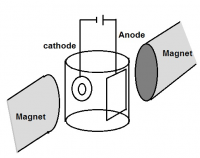
Fig. 1: Electrodeposition process setup

The electrodeposition of NiCo alloy has been investigated in presence of various magnetic fields. The influence of superimposed magnetic field (0-0.5T) parallel to the electrode surface on current efficiency, surface morphology, preferred crystal orientation and electrochemical activity of Ni-Co alloy were studied. The maximum current efficiency was obtained by direct current at 100mA/cm2 with 0.4T. The optimized current density (100mA/cm2) was pulsed at four different frequencies (10, 25, 50 and 100Hz) with the same magnetic field (0.4T). However, the superimposition of magnetic field significantly favors the preferred crystal orientation of (220) phase. Pulsed current deposits exhibit single orientation of (220) at lower magnetic field (0.4T) whereas direct current deposition require higher magnetic field (0.5T). Tafel plot shows that electro-catalytic activity and corrosion resistance property has improved when the deposit is having a preferred orientation of (220).


    

A new insight into the phosphorus distribution of nanocrystalline Ni-Ni3P-diamond composites

The microstructure of an electroplated Ni-Ni3P-diamond composite has been studied by field-emission scanning electron microscopy, energy dispersive X-ray spectrometry and transmission Kikuchi diffraction. The use of an electron transparent sample reduced the resolution limits of X-ray spectrometry and electron backscatter diffraction. Basing on the P distribution and Ni/Ni3P orientation maps, standard observations made by backscattered electron imaging can be easily interpreted.


Electroless Deposition of Palladium – Part 2

In Part 1 of this series on the electroless deposition of palladium, the properties of the metal itself were discussed as well as the benefits of the electroless deposition process. In Part 2, the autocatalytic position processes are detailed with an exhaustive review of previously published work in this area.

Link: Electroless Deposition of Palladium – Part 1


Electroless Deposition of Palladium – Part 1

Palladium is an interesting element in surface chemistry. It is a noble metal and an active catalyst in many  reactions. Palladium or palladium alloys are used in the fields of catalysts, electronics or hydrogen seperation or purification. One special application is its use as a catalyst for metallising non-conductors like platic materials. In this paper the literature concerning the deposition of catalytic palladium for the surface activation prior to the deposition of electroless nickel and other metals is reviewed.

Link: Electroless Deposition of Palladium – Part 2


Finite element simulation of nickel electroplating process of a revolving part

Fig. 2: Electroplated sample

Process simulation and optimization with the help of numerical methods can reduce expensive and time consuming experiments for manufacturing good quality products. Electroplating is a prominent coating process that the quality and uniformity of the deposition are of great importance in this process. In this paper a finite element model has been proposed for evaluation of primary and secondary current density values on the cathode surface in nickel electroplating operation of a revolving part. In addition, the capability of presented electroplating simulation has been investigated in order to describe the electroplated thickness of the nickel sulfate solution. Nickel electroplating experiments have been carried out and the measured thickness in different points have been compared with the predictions. A good agreement between the simulated and experimental results was found. Also the results showed that primary current density can describe the general form of thickness distribution but the relative value of current density using secondary current density can present better description of thickness distribution.