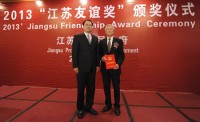
Advisory Board Member Prof. Dr. Siegfried Steinhäuser was awarded the Friendship Prize of Jiangsu Province (China)

Prof. Dr. Siegfried Steinhäuser and Mao Weiming

After having reached the 65th year of life in 2005, Prof. Dr. Siegfried Steinhäuser officially was officially retiring – but as adherent of TU Chemnitz he continues to work on his subject area (materials science) and engages i.a. in China. In September 2013 Prof. Steinhäuser was now honored with the Friendship Prize awarded by the Governor of Jiangsu Province, Mao Weiming, in the capital Nanjing. Jiangsu Province with its 80 million inhabitants counts among the most prospering provinces in China. Within a solemn act also other outstanding personalities from industry and academia, i.a. from Canada, India and Sweden, were honored. Continue reading…
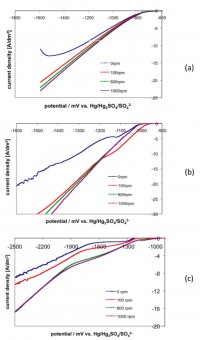

Pulse plating of nickel-based alloys

Fig. 1: Cathodic polarisation curves for (a) Ni-Co, (b) Sn-Ni and (c) Ni-W electrolyte systems recorded at a scan rate of 10mVs-1 on a rotating disk electrode at different electrode rotating velocity: 0, 100, 600 and 1000rpm

In the present work, nickel-based alloy coatings (Ni-Co, Sn-Ni and Ni-W) with different microstructures were produced under direct and pulse current conditions. These alloys are of interest as potential replacement for chromium based coatings, especially hard chromium. A replacement for hard chromium coating faces the challenge of providing sufficient hardness values.  For some sliding wear applications, hardness might not be required at the same level as hard chromium, and coating toughness might be more critical.
The effects of the pulse parameters (pulse waveform, pulse frequency and average current density) on the deposit structure and properties of these three systems have been investigated. Pulses have been defined based on the results of electrochemical measurements and numerical process simulation. The surface morphology, microstructure and microhardness of the deposit have been correlated to the pulse parameters applied.
The experimental results showed that applying pulse plating substantially altered the properties of the coatings. The resulting layers exhibited a nano-crystalline microstructure, improved layer compactness and hardness of the nickel-based alloy deposits.


Application of Gold Electrodes for the Study of Nickel Based Homogeneous Catalysts for Hydrogen Oxidation

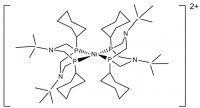
Scheme 1: Schematic presentation of Ni(PCy2Nt-Bu2)22+

Gold and glassy carbon working electrode materials are compared as suitable substrates for the hydrogen oxidation reaction with Ni(PCy2Nt-Bu2)2(BF4)2 used as a catalyst. Voltammetric responses showing electrocatalytic hydrogen oxidation mediated by the homogeneous electrocatalyst Ni(PCy2Nt-Bu2)2(BF4)2 are identical at glassy carbon and gold electrodes, which shows that gold electrode can be used for hydrogen oxidation reaction.


Surfin 2013

Surfin 2013

TRW and Elsyca present results of optimization project at SUR/FIN June 10–12, 2013 in Rosemont (Chicago)

1. Introduction

TRW Automotive Safety Systems and Elsyca NV presented the results of a collaborative project on a decorative part of a steering wheel at the SUR/FIN conference in Rosemont (Chicago). The visitors could, after the presentation, visit the booth where the steering wheel and some before/after parts were being displayed. Continue reading…

Electrodeposition of tin-cobalt alloy as a replacement for decorative chromium

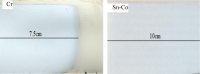
Fig. 6: Throwing power of Sn-Co electrolyte compared with that for decorative chromium

Tin-cobalt alloys were electrodeposited onto nickel-plated brass substrates using a pyrophosphate electrolyte. Deposition conditions were as follows: current density, 0.2-0.3 A/dm2, bath temperature, 45±2°C, pH 8-8.2, ratio of Sn:Co 1.2:1 and current efficiency, approximately 90%. The bath exhibited good throwing power. Deposit morphology was uniform, with cauliflower-like microstructure, mean grain size 125nm. Visual appearance was very similar to electrodeposited chromium with a bluish-white colour. Electrochemical corrosion measurements using Tafel extrapolation and impedance data (as Nyquist plots) showed that Sn-Co alloy and decorative chromium had comparable corrosion resistance with values of 7.77*10-7 A/cm2 and 200 000 Ωcm2 respectively. The results demonstrate that electrodeposited tin-cobalt alloy can be a viable replacement for decorative electroplated chromium.