Kinetics of Corrosion Inhibition of Aluminum in Alkaline Solutions by Water-Soluble Poly (Vinyl Alcohol) as Synthetic Polymer

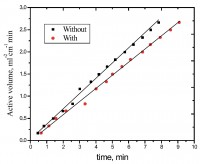
Figure 1.

The influence of water-soluble poly (vinyl alcohol) (PVA) as a synthetic polymer containing secondary alcoholic groups on the rate of dissolution of aluminum (Al) metal in alkaline medium has been investigated using both gasometric and weight-loss techniques. The results showed that addition of poly (vinyl alcohol) to the tested solutions leads to a remarkable decrease in the corrosion rates of Al in alkali. The magnitude of inhibition efficiency was determined and compared to that obtained with other macromolecules containing secondary alcoholic groups. The inhibition action of PVA on Al metal surface was found to obey Freundlich adsorption isotherm. Factors affecting the corrosion process such as the concentration and nature of the inhibitor, concentration of the corrosive medium and the temperature were examined. A tentative inhibition mechanism consistent with the kinetic results obtained is suggested and discussed.


    

Pulse plating of nickel-based alloys

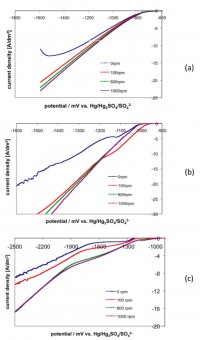
Fig. 1: Cathodic polarisation curves for (a) Ni-Co, (b) Sn-Ni and (c) Ni-W electrolyte systems recorded at a scan rate of 10mVs-1 on a rotating disk electrode at different electrode rotating velocity: 0, 100, 600 and 1000rpm

In the present work, nickel-based alloy coatings (Ni-Co, Sn-Ni and Ni-W) with different microstructures were produced under direct and pulse current conditions. These alloys are of interest as potential replacement for chromium based coatings, especially hard chromium. A replacement for hard chromium coating faces the challenge of providing sufficient hardness values.  For some sliding wear applications, hardness might not be required at the same level as hard chromium, and coating toughness might be more critical.
The effects of the pulse parameters (pulse waveform, pulse frequency and average current density) on the deposit structure and properties of these three systems have been investigated. Pulses have been defined based on the results of electrochemical measurements and numerical process simulation. The surface morphology, microstructure and microhardness of the deposit have been correlated to the pulse parameters applied.
The experimental results showed that applying pulse plating substantially altered the properties of the coatings. The resulting layers exhibited a nano-crystalline microstructure, improved layer compactness and hardness of the nickel-based alloy deposits.


Application of Gold Electrodes for the Study of Nickel Based Homogeneous Catalysts for Hydrogen Oxidation

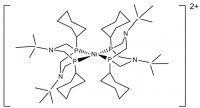
Scheme 1: Schematic presentation of Ni(PCy2Nt-Bu2)22+

Gold and glassy carbon working electrode materials are compared as suitable substrates for the hydrogen oxidation reaction with Ni(PCy2Nt-Bu2)2(BF4)2 used as a catalyst. Voltammetric responses showing electrocatalytic hydrogen oxidation mediated by the homogeneous electrocatalyst Ni(PCy2Nt-Bu2)2(BF4)2 are identical at glassy carbon and gold electrodes, which shows that gold electrode can be used for hydrogen oxidation reaction.


Choline chloride-Ethylene glycol mixture as electrolyte for nano crystalline Nickel electrodeposits

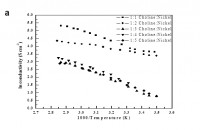
Fig. 1a: Comparison of conductivity of Ni(II) chloride dissolved in Ethaline complex

Nickel plating was carried out in stable Nickel ion based deep eutectic solvent (DES). The DES electrolyte stability and possible structure were explained by using Fourier Transform Infrared spectroscopy (FTIR) and Temperature Modulated Differential Scanning Calorimetry (TMDSC) techniques. The conductivity and electrochemical studies for choline based eutectic solvents were analyzed by conductivity cell and electrochemical impedance spectroscopy respectively. Higher current efficiency, thickness and hardness of Nickel were obtained by Pulse current electrodeposition when compared with Direct current electrodeposition. Crystallographic orientation and structural morphology were studied by X-ray diffraction (XRD) and Atomic Force Microscopy (AFM) respectively. Coated Nickel plate’s corrosion resistance and porosity properties were checked using potentiodynamic polarization and electrochemical impedance spectroscopy.


Electrochemical deposition and characterization of nanocrystalline Fe-Ni coatings

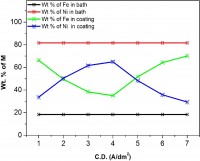
Fig.1: Variation of metal contents in the deposit with applied c.d.

Nanocrystalline Fe-Ni coatings were electrodeposited on mild steel (MS) panels at different current densities (c.d.) from an acid sulphate electrolyte. The operating parameters were optimized for best appearance and performance of the coatings. Different techniques like Field Emission Gun Scanning Electron Microscopy (FESEM), Energy Dispersive X-ray Analysis (EDXA), X-Ray Diffraction, potentiodynamic polarization scan and Electrochemical Impedance Spectroscopy (EIS) were employed to characterize the electrodeposited thin films. The electrodeposition process was found to be anomalous with 35% to 70% Fe, depending on the current densities (c.d.) employed for deposition. The properties of all coatings were found to show close dependency with c.d., phase structure and composition of the alloys. Corrosion behaviors were studied in 5% HCl and 5% KOH medium and corrosion parameters were reported. Experimental results are discussed by relating the composition, phase structure and grain size with corrosion performance of the coatings in both acid and alkaline medium.